Giorgio Gilestro
8da0dac007
Giorgio Gilestro
8da0dac007
Adds the union-preserving recombination operator that llm_merge lacked (E8's max,
not mean): keep each specialist LoRA intact and SELECT the right one per prompt
(MoE router: oracle, or training-free nearest-centroid over base embeddings) or
per module (max_merge = winner-take-all by delta norm). src/llm/moe.py, kind
llm_moe, reuses the cached specialists.

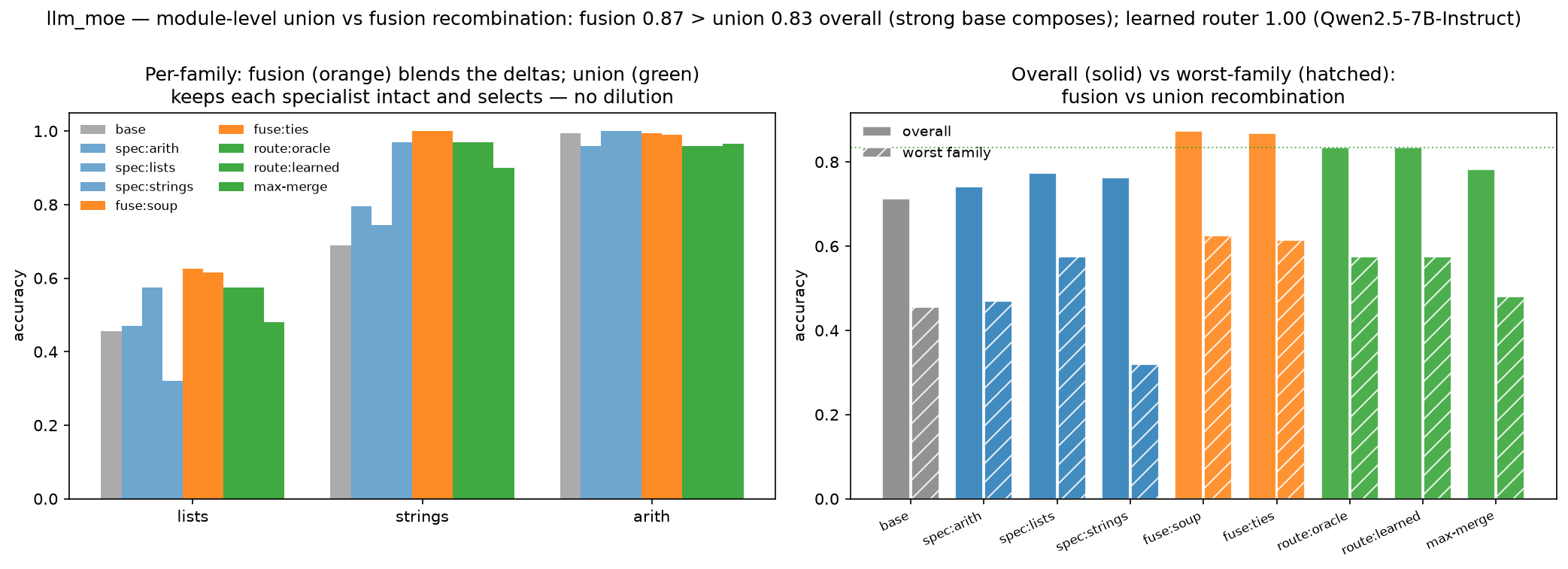
Result — a clean regime boundary for "merge, don't average":
- 0.5B: union wins. Routing 0.74 / worst-family 0.43 > soup 0.64 / 0.26, with no
  dilution (recovers each specialist's own-family peak). E8's max > mean in real
  weights, because at a weak base averaging dilutes.
- 7B (Imperial CX3, L40S, 9 min): the ordering INVERTS. Fusion wins — soup 0.87 >
  routing 0.84 > max_merge 0.78. Routing is capped at the best parent per family;
  fusion blends and, given a capable base, COMPOSES beyond any parent (soup lists
  0.62 > spec 0.57). Selection can't synthesise better than its best component;
  averaging-that-composes can.

So "merge, don't average" (E4/E8) is a weak-parent / small-model law, not
universal: union wins under dilution, fusion wins under composition. Refines E8
(its additive-landscape max>mean assumed no compositional headroom). The operator
to want is fusion-that-composes + offspring selection = the directed-sex ideal
(E10) — the natural next experiment.

Honest riders: the learned router is trivially perfect (lexically-distinct
families), and router-free max_merge is the weakest union (not input-adaptive).
+2 router unit tests (127 green). Results in results/llm_moe{,_hpc}/ (parquet
gitignored per the reproducibility contract).

Co-Authored-By: Claude Opus 4.8 <noreply@anthropic.com>
131 KiB
2085x756px
131 KiB
2085x756px