Giorgio Gilestro
db9452c9d4
Giorgio Gilestro
db9452c9d4
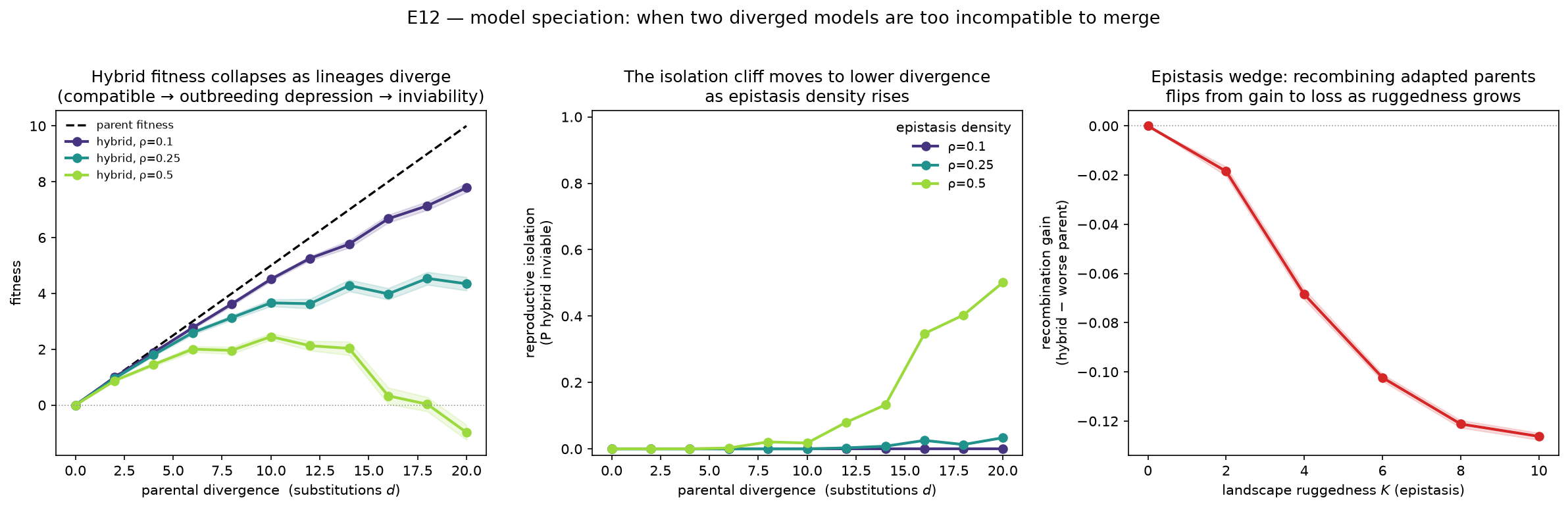
New analytic result for the evolution-of-sex paper: how far can two lineages
diverge before recombination (model merging) stops working? Frames merge failure
as biological reproductive isolation via Bateson-Dobzhansky-Muller
incompatibilities. src/knowledge/speciation.py, kind: speciation, on the E7-E11
genotype machinery (pure seeded NumPy, bitwise-reproducible; no external
simulator whose separate RNG would break that).

- BDM construction (E12.yaml): ancestor + two lineages substituting disjoint loci
  (each parent adaptive, incompatibility-free), a fraction rho of cross-lineage
  pairs are BDMIs. Sweeping divergence d reproduces the predicted
  compatible -> outbreeding depression -> hybrid inviability curve; the isolation
  cliff moves to lower d as epistasis density rises (iso at d=20: 0.00/0.03/0.50
  for rho 0.1/0.25/0.5); incompatibilities snowball ~ (d/2)^2 (Orr-Turelli).
- NK variant (E12_nk.yaml): parents = hill-climbed local optima; the epistasis
  wedge — recombination gain flips 0 -> -0.13 and OD rate 0 -> 0.90 as ruggedness
  K rises. At matched divergence, mergeability is governed by epistasis, the axis
  no divergence-only ML merge predictor captures.

plot_E12.py (3-panel), +7 tests (138 green), README with honest positioning
(concedes the empirical phenomenon to Pari 2024 / Zhou 2026 + permutation
artefacts to Git Re-Basin; claims the predictive theory + the epistasis wedge).
Wired into make layer1.

Co-Authored-By: Claude Opus 4.8 <noreply@anthropic.com>
241 KiB
2383x772px
241 KiB
2383x772px