Giorgio Gilestro
48181a1c84
Giorgio Gilestro
48181a1c84
Deepen the sexual-reproduction frame before entering the full society, on
the two facets GG chose: landscape robustness and directed recombination.
Adds a Kauffman NK landscape (genotype.nk_fitness, tunable ruggedness),
finite n-parent crossover (genotype.crossover, per-gap recombination rate),
and hill-climb (parents = local optima = trained models).

E9 (recomb_landscape) -- the "why sex?" test: E8's dramatic super-parent
result used an ADDITIVE landscape. On rugged/epistatic landscapes, blindly
recombining local optima causes OUTBREEDING DEPRESSION -- offspring fall
below the parents, worse with both ruggedness and recombination rate (K=8,
free recomb: ~ -0.23), and the optimal recombination rate shrinks as
ruggedness grows. Design rule: merge freely when skills are complementary/
additive; sparingly (and with selection) when entangled.

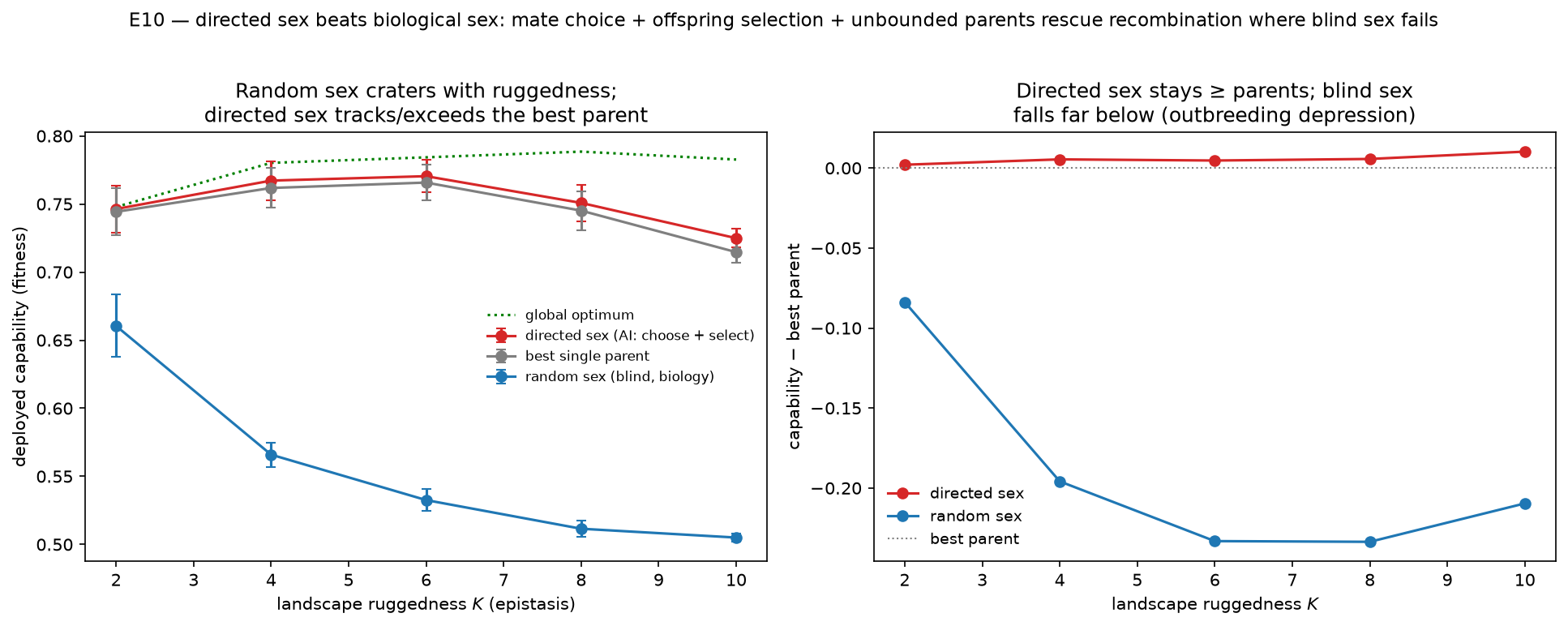
E10 (directed_sex) -- directed sex beats biological sex: biology is stuck
with 2 random-mating parents and no offspring preview; an AI can choose
complementary mates, evaluate many recombinant offspring, keep the fittest,
and use unbounded parents (iterated recombine-then-select). Random
("biological") sex craters with ruggedness (0.66->0.51); directed sex
tracks/exceeds the best parent at every ruggedness -- converting the
outbreeding-depression catastrophe into a win. No biological analog.

Complete sexual-transmission picture: dramatic super-parent offspring when
skills are complementary (E8); outbreeding-depression risk when entangled
(E9); directed sex resolves the risk (E10). configs/layer1/{E9,E10}.yaml,
figures/plot_{E9,E10}.py, READMEs, +5 tests (117 green).

Co-Authored-By: Claude Opus 4.8 <noreply@anthropic.com>
174 KiB
1934x772px
174 KiB
1934x772px